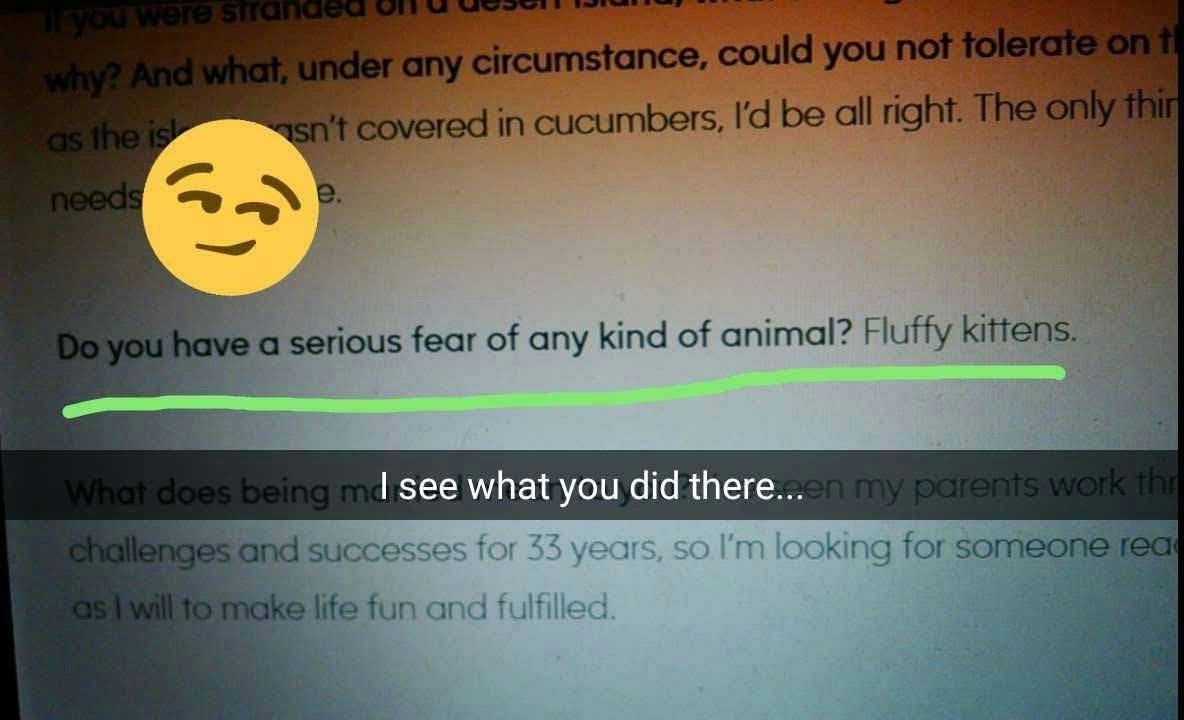
(I do apologize for poor picture quality. I was taking pictures of a computer screen - a sketchy proposition to start with - with a blue-light filter on so everything looks a little pink. Incidentally, I highly recommend Twilight for your phone and f.lux for your desktop; I legit think it's improved my sleep that I don't have that blue light blaring in my face at night!)
I'm Katherine. I was in school for over 19 years. Now I'm trying to be an adult. Mostly I just make things up as I go along. (Shh! Don't let Them know!)
Wednesday, May 18, 2016
In which I stereotype some men
So Monday night I spent some time going through the new "Bachelorette" contestants, in preparation for the season premiere next week. Obviously this is not a solo endeavor, so I shared my thoughts in an epic Snapchat story, which I now present, without additional comments, here for you. You're welcome.
(I do apologize for poor picture quality. I was taking pictures of a computer screen - a sketchy proposition to start with - with a blue-light filter on so everything looks a little pink. Incidentally, I highly recommend Twilight for your phone and f.lux for your desktop; I legit think it's improved my sleep that I don't have that blue light blaring in my face at night!)
Friday, August 1, 2014
Seasons
Fall is absolutely
my favorite season. Winter is cold (horrible) but at least has the upside of
cocoa and my birthday. Spring is warm and lovely and green.
But there's
something about the way summer smells that is magical. Like when your skin
smells of sunscreen and outside and maybe a tiny bit of sweat so it feels like
you absorbed the sunshine and get to emit back to the world a little bit. Like
when the bathroom smells of chlorine or salt as bathing suits and towels hang
to dry, summoning the refreshing feel of water on your skin on a hot day. Like
when you can tell someone is grilling hot dogs and hamburgers, taking advantage
of hours of daylight in the long evenings.
Summer comes with
the sort of smells that just make you feel alive and hungry, ready to get
outside and gobble up all the delicious daylight you can before the Earth tilts
away from the sun. As though days that seem to last forever mean the good times
will, too, and any troubles will pass like a Carolina thunderstorm, here one
minute but gone to reveal clear skies the next.
Because summer is
the time when youth runs free, no school or job to worry about, capturing those
smells to save up for winters and the years when free time is harder to come
by. And then, in a break from the everyday humdrum work week, you catch a whiff
of sunscreen and chlorine and feel unburdened for a moment, and life is good
again.
For real, though,
I'm ready for fall. Two months of summer is enough for me.
Tuesday, May 27, 2014
Is it worth wearing real clothes?
Pop quiz:
Reasons you should wear a stretchy headband:
Follow-up bonus question: Which of those reasons were my basis for wearing a stretchy headband to the grocery store today? (Hint: None of the reasons that should be correct.)
(I mean I guess I shouldn't really care whether people think I've been working out or just haven't showered in 3 days and couldn't be bothered to wear anything more than workout clothes, but I do like to try and pretend to myself that I'm a real, functioning adult human. And part of that consists of convincing myself that other people will believe I'm a responsible adult, who showers and wears real clothes most of the time and gym clothes only when I'm working out, not all the time like socially-acceptable pajamas.)
Reasons you should wear a stretchy headband:
a) It's a fashionable accessory for your outfit
b) To disguise that your hair hasn't been washed for 3 days
c) You just came from working out, where you needed to keep hair out of your face
d) You want to pretend that you just came from working out so people won't judge your lack of real, adult clothes
e) Just because you wanted to, who cares what anyone else thinks?
Follow-up bonus question: Which of those reasons were my basis for wearing a stretchy headband to the grocery store today? (Hint: None of the reasons that should be correct.)
(I mean I guess I shouldn't really care whether people think I've been working out or just haven't showered in 3 days and couldn't be bothered to wear anything more than workout clothes, but I do like to try and pretend to myself that I'm a real, functioning adult human. And part of that consists of convincing myself that other people will believe I'm a responsible adult, who showers and wears real clothes most of the time and gym clothes only when I'm working out, not all the time like socially-acceptable pajamas.)
Wednesday, April 16, 2014
Is weirdness genetic?
Or: My parents are rather strange and twisted
When I was younger, my parents used to sing to my sister and I. Mostly for things like bed time: "Bed time, for Katherine, and Emily!"
Sometimes for bath time: "Bath time, for Katherine, and Emily!"
Occasionally for other things, and sometimes they'd add another verse.
They did on rare occasions sing the original words to the song, but it was only very recently, when I actually watched "The Producers," that I made the connection and thought about exactly how strange it would sound to other people that my parents sang to us to the tune of "Springtime for Hitler."
(Alright, I spent way more time than I should have trying to figure out how to embed this video and start it at a particular time - no thanks to either Youtube or Blogger, because I'm doing everything they say should work and it doesn't seem to... Anyway, just start the video at 52 sec. to get the tune, if you don't already know it!)
(I'll give you a minute to imagine bed times of my youth.) (Also I chose this version because John Barrowman.)
My mom revealed that she was shocked the first time my dad did this. (This is me, making a completely unsurprised face that this was begun by my father.) Of course, that didn't stop her from joining in.
Saturday, February 1, 2014
Only a month late!
Dear Self,
That was real great when you made those resolutions... Except you didn't really keep them!
Alright, you got an apartment. And you read 29 books, which is pretty decent even if it's not 35.
Let's admit that the crafting just didn't happen and move on. (There was plenty of baking, though, so good job on that and let's keep that up!)
And hey, you went to both D.C. and Boston, so major props on the travel front. (Also Harry Potter Camp, which I can't believe you didn't write about yet! Falling down on the blogging front, there.)
I was going to say that resolutions clearly don't work for us, but in hindsight 2013 was a pretty amazing year. Didn't complete the stuff we originally intended, but some really awesome things happened. So I think it's justified to try and make some new goals for 2014:
Okay, that's quite a bit. We don't want to feel overwhelmed by our own ambitions! I am cautiously optimistic about this list, though, so we'll see how it went when 2015 rolls around.
That was real great when you made those resolutions... Except you didn't really keep them!
Alright, you got an apartment. And you read 29 books, which is pretty decent even if it's not 35.
Let's admit that the crafting just didn't happen and move on. (There was plenty of baking, though, so good job on that and let's keep that up!)
And hey, you went to both D.C. and Boston, so major props on the travel front. (Also Harry Potter Camp, which I can't believe you didn't write about yet! Falling down on the blogging front, there.)
I was going to say that resolutions clearly don't work for us, but in hindsight 2013 was a pretty amazing year. Didn't complete the stuff we originally intended, but some really awesome things happened. So I think it's justified to try and make some new goals for 2014:
- Travel: get back to Camp 9 3/4; going to DC is a given; and it would be nice to visit family in Buffalo this summer.
- Read: let's be a little less ambitious and set a goal of 30 books this year. Also, get a new library card, since apparently that old one we haven't used in about 7 years is no longer good.
- Blog: I really don't think one post a month is asking too much!
- Learn: take some classes! Could be online, or through the city's Parks Department, or even a community college course.
Okay, that's quite a bit. We don't want to feel overwhelmed by our own ambitions! I am cautiously optimistic about this list, though, so we'll see how it went when 2015 rolls around.
Love,
Me
Tuesday, January 21, 2014
Books of 2013
I've
been keeping track of the books I finish in a given year for a couple years
now. Here are the books I read in 2013:
- Undead and Unemployed by MaryJanice Davidson
- The Neverending Story by Michael Ende (translated by Ralph Manheim)
- M or F? by Lisa Papademetriou and Chris Tebbetts
- Pride and Prejudice by Jane Austen
- In the Stone Circle by Elizabeth Cody Kimmel
- Five Little Peppers Midway by Margaret Sidney
- Selected Poems by Robert Browning, ed. William C. DeVane
- Harry Potter and the Prisoner of Azkaban by J. K. Rowling
- Many Waters by Madeleine L'Engle
- James and the Giant Peach by Roald Dahl
- The Book of Animal Ignorance by John Lloyd and John Mitchinson
- Attack of the Deranged Mutant Killer Monster Snow Goons by Bill Waterson
- North to Thule by John & Harriet Frye
- Friendship Cake by Lynne Hinton
- The Secret Life of Bees by Sue Monk Kidd
- The Lovely Bones by Alice Sebold
- Black and Blue by Anna Quindlen
- Dragonfly in Amber by Diana Gabaldon
- Eight Cousins by Louisa May Alcott
- To Be or Not to Be: A Choosable Path Adventure by Ryan North and William Shakespeare
- Poor Yorick by Ryan North
- Changes by Danielle Steel
- An Altar in the World by Barbara Brown Taylor
- Little Men by Louisa May Alcott
- Five Children and It by E. Nesbit
- A Short History of Nearly Everything by Bill Bryson
- Jo's Boys by Louisa May Alcott
- Swift Rivers by Cornelia Meigs
- The Law of Love by Laura Esquivel
Honestly,
I had hoped to read a few more… (I did get partway through Middlemarch by George Eliot, but about 200 or
300 pages in, I just wasn't invested enough in the characters to continue. I
looked up the plot summary because I was interested in how things worked out, but I just couldn't stomach wading through
another 400 pages to get to those resolutions!) I've been hoping for a while
that I might manage to get to 50 books in one year, but I seem to be stuck
right around 29 or 30. I think if I'm not getting distracted by work or other
obligations, I'm distracted by the internet. It's possible it would help to
only read one book at a time, instead of constantly being in the middle of 3 or
4 books at once, ha.
General
reviews:
Favorites
were, I think (excluding Harry Potter because that's not even fair), The Secret Life of Bees, and the Calvin &
Hobbes collection. The Lovely Bones was
really good, although incredibly creepy and unsettling. Oh, and of course the
choose-your-own-Hamlet was amazing. (Not that I'm biased because I helped fund
its publication or anything…)
I
did not like the Danielle Steel novel at all, which I was a little surprised
by. Not that I'm huge into romance novels, but I like a trashy novel every once
in a while, and I assumed I couldn't really go wrong with something by someone
so successful. Big mistake. I might as well have picked up Twilight. The
characters started out relatable enough, but as the plot progressed it just
lost me. And then I got to the scene where the father character slapped his
oldest son across the face. And I was just done. I don't care that the book was
written in the 80's or whatever, that's not really acceptable to me. And to
have the female protagonist not say a word about it… Ugh. Just… over it. (There
might also be a scene where the same guy hits the female protagonist? Again,
not okay. It just made me want to throw the book across the room.) This was
definitely a book I finished by dint of sheer stubbornness. I was also kind of
disappointed with the conclusion of Black and
Blue, but I guess things can't always end happily if you're trying to
write "realistic" novels.
Sunday, September 15, 2013
Adulthood is a Lie
The title of this
blog might give it away, but honestly it's how I'm getting through life: I'm
really just faking it. I make it up as I go along and hope things turn out
okay!
I recently started
helping out with leading the Youth Group at my church. (They want someone
younger - and not anyone's parent - to be a "role model" for the
kids. And they picked me. I think it's crazy, too.) I'm not sure when, but at
some point I really think we might have to have a discussion about being a
Grown-up and how it never actually really happens. Like, I pay my bills on
time, yes, and have a functionally clean apartment (not spotless, but it'll
do). Technically, I am an adult. But… I don't feel like it.
No one tells you
when you're a kid that Adulthood isn't some magical state where you always know
exactly what to do, exactly when to do it, and all your problems can be easily
solved. (I'm sure I'm not the only one who thought of it this way; I'd hit some
magic "adult" age like 20 or 25 and have everything figured out, life
would always make sense, I'd have all the answers. I'm pretty sure I felt like
I had more of the answers at 16 than I do now.) You just assume that you'll get
through school, get a job, and you'll be an Adult who can be totally
responsible and do Adult things and solve everyone's problems. (In retrospect,
that was a silly expectation, considering the number of times I thought adults
were doing a pretty shitty job of running things. But of course, I'd be a Real
Adult and never have those problems!) And then you achieve one goal, but no,
you're not really an Adult yet, you don't have a Big Kid job, you're still in
school. And then you finish grad school and know that you'll be an Adult when
you've got an apartment of your own. Except Real Adults have apartments that
are nicely furnished and decorated, and you've only got half the curtains up on
one set of windows (true story), so you clearly don't count yet. And you don't really
have responsibility for any living things yet (certainly not children, as that
would be terrifying, but not even a dog, just a snake, and that doesn't really
count because they're so low-maintenance) so clearly you're not a Real Adult.
And some days you don't do your dishes, and you haven't vacuumed in ages so
there is hair everywhere, and sometimes you don't even shower (let's not even
talk about the chocolate explosion that you still haven't cleaned off your car
seat), and Real Adults wouldn't have the sorts of problems with motivation that
you have. They might have lists a mile long of all the things they want to
do (like make a cool header for their blog, or finish hanging the curtains in
their living room, or actually clean their apartment, or alter some clothes
they picked up at the thrift store two years ago) except they actually do them.
Except that's
wrong. Because (alright, I could be wrong about this too) I think we all just
spend our lives kind of blindly groping our way toward our next goal,
pretending like we're super-productive Real Adults who can Do It All and Have
It All and still get enough sleep. (And some of us will actually admit to
pretending.) I, for one, would just like to acknowledge that I'm a Real Person, just a silly little human who makes
mistakes and doesn't know everything and is just trying to get through my life
and maybe improve myself a little bit, if I'm lucky that day. I'm getting
better at forgiving myself for not living up to my own ridiculous expectations;
I am me and if sometimes that means the
only thing I accomplish in a day is making a lunch to take to work then that is
enough, I am enough, and I can try again
tomorrow to be a better version of me, but if I don't succeed tomorrow I can
try again the next day and all the days after that.
So I think we should start telling kids that
growing up never really ends. You never really become a Real Adult because we
think of Real Adults as capable of doing All the Things! And no one can ever do
that. (Certainly not me.) And if we can admit that to ourselves, and forgive
ourselves for that, then maybe we can admit that about other people and forgive
them and end up living in a kinder, gentler world. Which would be nice.
Saturday, April 20, 2013
Evo Psych: the worst?
My plans for the day had included going to a football scrimmage with friends. Unfortunately, I woke up with a cold so I'm spending the day on the couch instead. So I'm writing a blog post, which hopefully doesn't sound too delirious!
Just to warn you in advance, I have Opinions on evolutionary psychology. Mainly that it is, by and large, a bunch of bull. Sorry I'm not sorry, but humans are influenced way too much by culture to make most of the conclusions that EvoPsych papers try to make. So that's my disclaimer. I'm skeptical from the start of papers that try to draw conclusions about biological gender differences between humans, and when you try to account for those differences by saying, "Because evolution!" I usually just roll my eyes.
A few days ago a coworker posted a link on Facebook to this article, "Why Don't Men Understand Women? Altered Neural Networks for Reading the Language of Male and Female Eyes." I was intrigued, because of my aforementioned skepticism about gender-based science, so I clicked through to read the article. (Side note: I really do appreciate open-access journals!)
First, I noticed they have a really limited sample of subjects. Only men. All of whom were single. And right-handed. Hardly a representative sample of a population. They did describe some interesting phenomena regarding these men's ability to recognize gender and emotion just from looking at eyes, and what sort of brain activity occurs during those tasks. But that's all they did - describe phenomena observed in a particular subset of a particular gender. What sort of differences might be found if comparing single men and married men? Straight men and gay men? Cis- and transgender men? Or (imagine!) men and women (of various categories)?
My major issue with this paper came up when I read their discussion, which included this: "From an evolutionary point of view, accurate interpretations of other men’s rather than women’s thoughts and intentions, especially threatening cues... may have been a factor contributing to survival in ancient times. As men were more involved in hunting and territory fights, it would have been important for them to be able to predict and foresee the intentions and actions of their male rivals." I kind of wish this was like Wikipedia so I could flag this with a little [citation needed]. Based on my (admittedly limited) knowledge of modern hunter-gatherer tribes (who are typically raised as the best example we have of early, pre-agricultural human society), there's not much in the way of defending territory that goes on. And I'm pretty sure hunting would actually involve more cooperative communication - running down antelope and other large game isn't what I would call a solo activity.
See, human behavior is... complicated. It isn't a result of simple cause-effect relationships. It's more like a big ball of wibbly-wobbly, culturey-naturey... stuff. (H/t to Steven Moffat for writing "Blink") Which is to say, untangling which behaviors are largely "natural" and biologically based from those that are mostly influenced by culture is incredibly difficult, if not impossible. On top of that, to make conclusions about gender differences, it would help to actually compare the genders. Which, as far as I'm concerned, is where all the really interesting questions arise (and maybe, if you're lucky, get a bit of an answer). Do women's reactions parallel those of men - are they better at identifying a) members of their own gender and b) the emotions of their own gender? Or are they the opposite - are women also better at identifying men and men's emotions? Once you know that, you can actually start making guesses about why you got those results. Perhaps there is some biological basis to emotional recognition, such that it's easier within your own gender. Or perhaps there are cultural factors at work - men and women might tend to have more friends of their own gender and thus more experience interpreting emotions of their own gender. Maybe men and women both get more practice empathizing with men because the majority of authority figures in business and protagonists in media are male. The "default hero" figure is generally male; media focused on female protagonists is often marketed mostly or exclusively to females (see: every "chick-flick" and romantic comedy, Disney princess movies), while media focused on male protagonists is viewed as accessible to men and women.
Even if you want to limit your sample to men, you could try throwing in a little variety by including married men (or left-handers?). Again, once you expand your sample you can actually make comparisons and try to draw conclusions somewhat legitimately. Alright, realistically, you'll probably only generate more questions with no answers. But at least you'll have something actually interesting to discuss! Are married men better at reading women's emotions than single men? Is that a causal relationship (men who are better at understanding women are more likely to get married) or a result (being married gives men more practice at interpreting women's emotions)? Or are all men, regardless of marital status, better at reading men's emotions than women's emotions?
As is, this paper does nothing more than describe particular neurological phenomena related to emotion recognition by men. Once you actually compare different samples (e.g., men vs. women, single vs. married), you can start to make some valuable, legitimate conclusions about how modern human behavior works. Not necessarily about how humans evolved. Making evolutionary conclusions requires actually demonstrating selective pressures and how they impact trait expression, which this paper very obviously does not do. (And, all things considered, most human studies can't hope to do, which is why EvoPsych is a bunch of malarkey.)
In conclusion: Science - you're doing it poorly.
Thursday, March 14, 2013
Adults: they take care of stuff
One thing I do know about being an adult is that it involves being responsible. Lots of days, I feel like I don't really have my life together, so how can I possibly qualify as a grown-up? Then I remind myself that a) many people - including people much older than me - don't have their lives "together" in terms of knowing what their ideal career is and b) I do my best to behave responsibly by paying my bills on time and keeping my apartment relatively clean and trying not to run my car into the ground and caring for my plants and pet.
One of my coworkers (who is 26 or 27) will be taking guardianship of her 12-year-old cousin in a couple weeks because of a bad family situation. The boy's mom died recently, and his father has been... acting out, for lack of a better word - staying out all night, forgetting to buy food, forgetting to take his son to school, dating inappropriate women (inappropriate in that the ladies don't call him out on his BS in not caring for his kid). She's a little freaked out. At the same time, she knows it'll be better for him than living with his father right now. And she's planning to take a new job that will let her work "normal" 9-5 hours. She'll be missed by us (I'll definitely miss her!), but this job is better for her career-wise, and certainly better for someone who has a pre-teen kid.
So, while I would be more terrified than my coworker at suddenly finding myself taking care of a human child, it has helped me realize that, in the essential things, I'm doing a pretty good job at being a real adult. I recognize when things depend on me, and I get things done in an appropriate time to take care of stuff. It's a reassuring thought that, should a crisis suddenly arise, I have the skills and coping mechanisms (and a pretty great social support network to call on!) to deal with it. So I guess I actually am a fully-functional adult? Such a weird thought.
Sunday, March 3, 2013
Growing-up 2: Escape from Suburbia
Boring things you
have to do when you move out of your parents' house (again):
- Go grocery shopping
- Do all your own dishes
- Do your own laundry
- Pay your own bills
- Be in school Nevermind, that's done! (Thank goodness!!)
- Cook meals for yourself, or else you really will be taking PB&J sandwiches to work every day
Basically, there
are a few perks to living at home. Especially when your parents are really
awesome and actually save leftovers for you to take to work. But… there are
also
Awesome things you
can do when you live alone:
- Pee with the door open
- Leave dirty dishes in the sink because the only one getting mad at you will be… you
- Procrastinate from doing the dishes by writing blog entries
- Clean at 1 am
- Cook at 1 am
- Make crafts at 1 am
- Have dance parties at 1 am
- Basically, do whatever you want at whatever time you want
- Fill the fridge and pantry with only your own food
- Get dressed in the living room while watching TV (you can't judge me because a: it's the warmest room and it's still winter and b: I do what I want!)
What's that you say? Have I already completed one of my New Year's Resolutions? Yes, in fact, I have!
Technically, I'm doing okay on the second resolution, as well, since in February I decided I wanted to try and cut high fructose corn syrup out of my diet as much as possible. My goal for March is to actually get legitimately unpacked, I think. I moved into my apartment over a month ago, and I still have boxes of stuff sitting around. It's a problem! Also, I need to improve my organization, which will help with getting unpacked. Two birds, one stone. That's how I do.
Subscribe to:
Posts (Atom)